We Deliver Smarter, Easier, More Secure Middleware Management
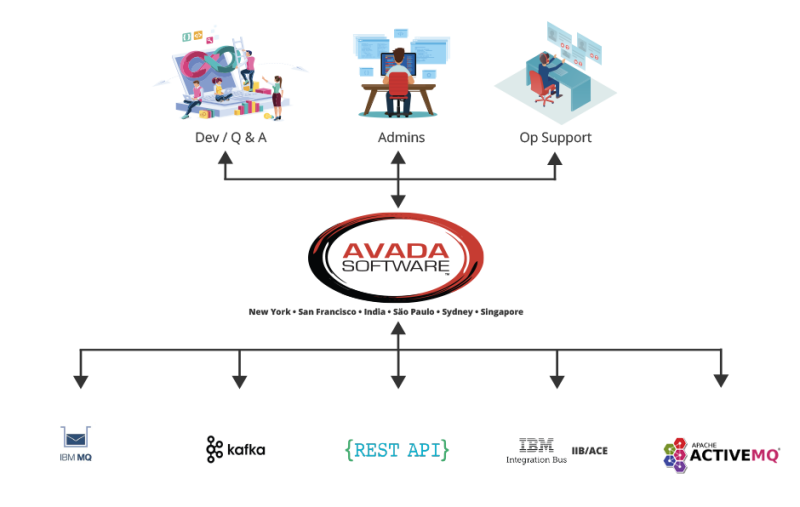
Infrared360® empowers your business with a single-interface solution for comprehensive monitoring and management of diverse middleware infrastructure like IBM MQ, Kafka, ActiveMQ, and more. Improve operational efficiency by streamlining your middleware operations with Infrared360®’s intuitive interface and automated processes. Experience a significant reduction in response times and operational costs.

Real-time & Historical Analytics
Provides end-to-end observability to your entire middleware environment.

Reliable and Proactive Monitoring
Leverage True Real-Time™ analytics and comprehensive middleware administration to anticipate issues and maintain consistent uptime.

Secure Collaborative Self-Service
Our Trusted Spaces™ feature provides a secure, role-based access system, enabling efficient collaboration across teams and departments.

Simplified Compliance and Auditing
Navigate security audits with ease, thanks to Infrared360®’s complete audit trails and advanced security features.

Scalable and Versatile Solution
Adapt effortlessly to evolving business needs with a solution that scales across thousands of middleware endpoints, suitable for cloud, on-prem, or hybrid environments.

Improved Performance and Reliability
Powerful capabilities like synthetic transactions, load testing, process automation & more, let you take the performance and reliability of your middleware to the next level.
Introducing Q-Guard: Our Middleware Monitoring & Administration PaaS
Q-Guard, Avada Software’s cloud-based Middleware Monitoring & Administration Platform-as-a-Service, offers a range of benefits tailored for efficient middleware management. It focuses on proactive monitoring to prevent downtime and eliminate hardware investment and maintenance. Q-Guard also provides easy access to real-time data and analytics, making it an effective solution for monitoring & administering your middleware environments IBM MQ, Kafka, ActiveMQ, and more.
For a comprehensive understanding of Q-Guard’s features and advantages, visit Middleware Monitoring PaaS.
Explore the Power of Infrared360®: Advanced Middleware Management Features
Middleware Management Use Cases for Infrared360®
Discover How Our Middleware Management Solutions Have Helped Organizations Across Various Industries

USBank, a leading financial institution, faced unique challenges in managing its IBM MQ environment, crucial for application integration and operational efficiency. With a complex and growing infrastructure, USBank needed a solution that offered robust monitoring, user authentication, and no additional workload for developers. Infrared360® by Avada Software emerged as the ideal solution. It provided a browser-based interface for easy access, LDAP integration for enhanced security, and powerful, customizable rules for proactive management, significantly reducing reliance on development resources and ensuring regulatory compliance.
Explore how USBank transformed its middleware management and bolstered security with Infrared360®

Parker-Hannifin Corp is a global leader in motion and control technologies serving over 49 countries. With technology teams in more than 500 locations, they needed a middleware management solution that provided persona-based access to their environment while ensuring proactive monitoring to avoid any adverse impact on transactions in their supply chain. Infrared360® proved to be the perfect solution for their integration and data security challenges, enabling simple middleware administration and monitoring while ensuring secure and collaborative operations.
Discover how Parker-Hannifin Corp achieved efficient and effective middleware management with Infrared360®.

Sompo Int’l Holdings is a global specialty provider of property and casualty insurances. As a result of growth from mergers and acquisitions, the company required an enterprise integration platform to manage their expanding business needs. The platform team needed a solution that provided insight into the performance of web services-based traffic to ensure low latency and high integrity. In addition, they required a solution that could identify issues proactively and prevent any negative impact on customers. Infrared360® provided the ideal solution for Sompo Int’l Holdings, simplifying their enterprise integration and improving their performance monitoring while ensuring efficient and effective operations.
See how Infrared360® seamlessly works with growing enterprises with disparate and legacy systems
What The Industry is Saying
See why our customers rave about Infrared360® & Avada Software!
“Great MQ administration tool”
“Avada’s IR360 is a great tool because they’ve built their extensive knowledge of MQ into it. They understand what information and abilities are necessary to administer MQ and IR360 simply delivers. And the support of the product is excellent.”
 MQ Administrator, Government
“Great product for both MQ administration and MQ monitoring/alerting”
“As an MQ administrator, I estimate that IR360 provides an order of magnitude reduction in the time normally required to perform MQ administration tasks using competing products. I’ve used many monitoring/administration tools, and IR360 shines in comparison”
IBM MQ Administrator, Banking: 1B - 3B USD“Fast Implementation, Direct Support From The Company, Quick Updates.”
“Use case: Within a large environment of a distributed solution running in 4 operating centers for approx 20 tenants, we use approx. 200 queue managers (IBM MQ). The need was to monitor those queues and give access to select personal with different access rights (such as seeing everything is up and running, or reading contents, or even change them, always depending on their role). We evaluated and decided for Infrared360. Experiences: our various stakeholders use Infrared360 frequently. They have access to “their” queues as needed. Our operations department manages the whole with just one part time person.”
 ICT Architect, Miscellaneous
“Avadasoftware IR360 Support Is A+”
“Support with Avada Software is incredible. They are responsive, personal and every part of the process is “white gloved.” I’ve even taken issues to their support not related directly to the their product that they’ve been able to help troubleshoot just because they care about their customer.”
 Manager Infrastructure Support, Finance: 1B - 3B USD
More Reviews
Thank you for the presentation of your product. What impressed me most was the architecture behind the product and how this provides rich capability and flexibility. There is data standardization, abstraction, pattern based design, independence, unitized services with configurable rules, message queues, and a few very good interfaces on top of it all. Nice to see solid architecture put into practice.
“We’re doing very well. We kept the old product server around, fearing that we’d run into a lot of people screaming about one thing or another. However, everything has gone smoothly and we never had to go back not even just to look at a configuration. It’s just gone really well.”
Thanks for all your support.
Infrared360® has the flexibility we need. Great tool to configure and manage large environments; very robust components.
I must say you really blew me away with the demo! Avada seems to be setting the bar for capabilities needed to manage a messaging environment of large scale environments. Great job and feel free to pass my initial observations along to others.
It takes us 80% less effort to manage our middleware environment using Infrared360®.
Infrared is still easily the best product out there.
I *love* Infrared360®.
Since converting to Infrared360®, we have been impressed with the flexibility of the architecture and the performance we have experienced. Infrared360® is faster and easier to use than our previous MQ monitoring software.
Avada Software listens to its customers; it doesn’t just hear what we say.
The main argument for the selection of Infrared360® was that you don’t need agents on the monitored servers.
We can now monitor queue managers in areas, locations, and practices, that we never had access to before … on any platform!
The pricing of the product is very good compared to similar tools.
Avada Software support is very professional and any fixes were delivered very fast.